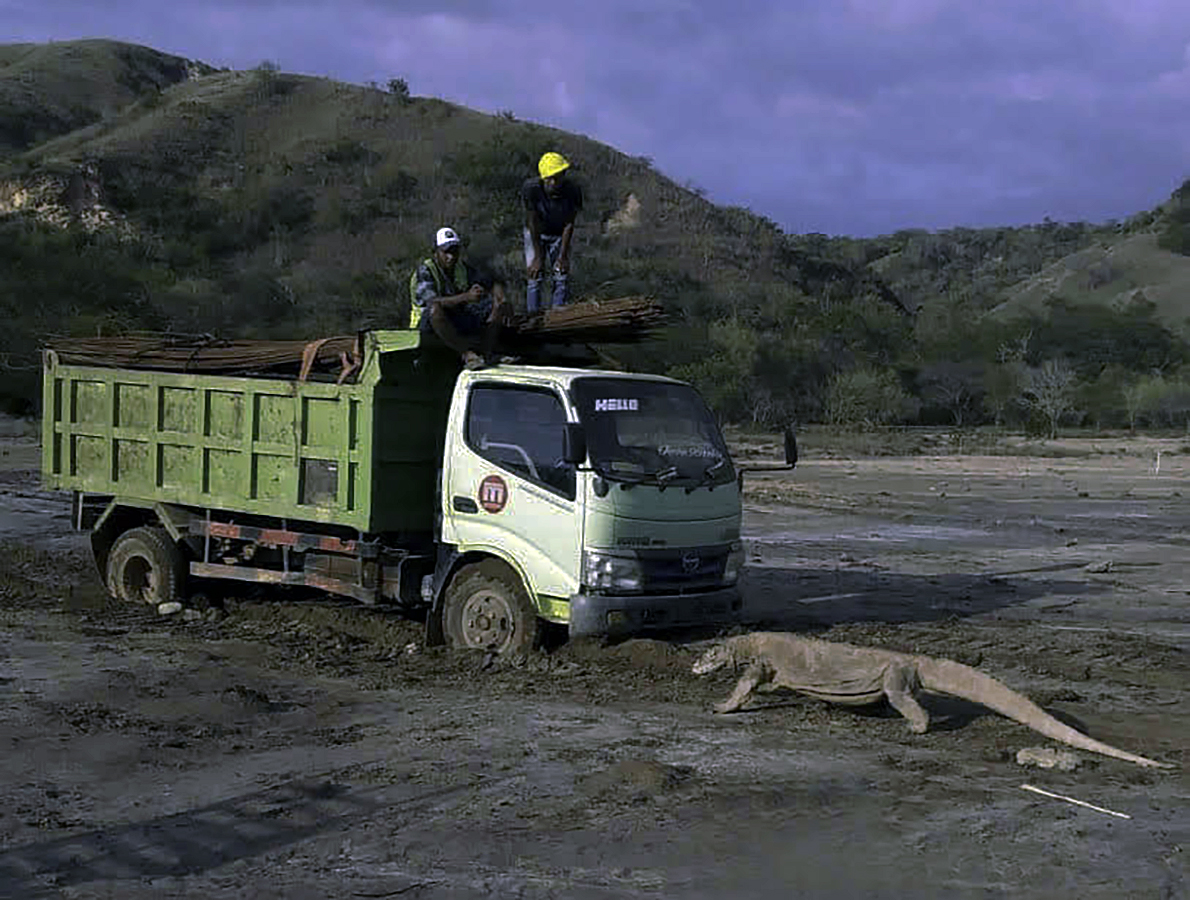
In Komodo National Park in Eastern Indonesia, home to the world’s largest lizard, the Komodo dragon (Varanus komodoensis), or Ora and Sebae in the local language, residents and social movement actors have challenged the exclusionary ecotourism development promoted by the government, international conservation agencies, and corporations. They do so by emphasizing a kinship with the dragon as a foundation for their resistance. Rooted in animist relational cosmologies common among indigenous communities in the region, the Ata Modo community sees the Komodo dragons as twins of humans, born from the same mother. This kinship relation plays a significant role in their opposition to a government and corporate-driven fortress conservation and ecotourism model. It also fuels their grassroots ecotourism practices. Based on ethnographic research into Ata Modo’s tactical engagements with conservation and ecotourism projects, this article explores a form of indigenous multispecies politics that offers an alternative paradigm for thinking about and approaching ecotourism development in protected areas.
The study was published in Critical Asian Studies on 3 October 2025.
Author’s Comment
This article is derived from a larger ethnographic and historical research project that examines conservation, tourism development, and social movements in Komodo National Park. Building upon critical studies of conservation and ecotourism, I am interested in examining the mobilization of ecotourism for conservation and development purposes, as well as its instrumental role in the commodification of nature for capital accumulation. In this article, however, I also address how Ato Modo, the indigenous residents of Komodo Island, engage with ecotourism not only as targeted beneficiaries of state-sponsored and corporate-driven ecotourism projects but also as active actors who negotiate with power holders, resist these projects, and seek an alternative model of ecotourism. In particular, I elucidate how they frame themselves as indigenous and use multispecies politics as a foundation for their engagement with ecotourism. In its place, they articulate a model of ecotourism from below. This alternative paradigm is not rooted primarily in a political-economic critique familiar to social movements in the Global South, but rather in a political process and a particular understanding and practice of human relations with other species and the environment in which they are part.
Researcher
Cypri Jehan Paju Dale Affiliated Researcher, CSEAS Kyoto University
Publication Information
| Title | Dragon Not for Sale: Commodification of Nature, Indigenous Multispecies Politics and Ecotourism from Below in Komodo National Park, Indonesia |
| Author | Cypri Jehan Paju Dale |
| Journal | Critical Asian Studies |
| DOI | 10.1080/14672715.2025.2566488 |
Related Information
Cypri Jehan Paju Dale, “Puzzling Confluence of Conservation and Ecotourism in Komodo National Park, Indonesia,” Japan-ASEAN Transdisciplinary Studies Working Paper Series, 2020. DOI: 10.14989/TDWPS_10.
Cypri Jehan Paju Dale, “Conservation, Ecotourism, and the Extractive Anthropocene in Komodo National Park, Indonesia,” CSEAS Newsletter 79 (2021): 9–11.
Cypri Jehan Paju Dale, “Working Politically with Knowledge,” 東南アジア地域研究研究所ニューズレター No. 6(2022).